Never read about it, never noticed the street sign on the hundreds of times I’ve walked past it on my way to and from work.
There’s no neighbourhood guide in Time Out, it’s not in any blogs. Google’s results are equally sparse: the first result is an article from 2006.
But I found myself in this quiet street between Angel and Kings Cross on Tuesday evening and immediately got that odd, uniquely London sense of going back in time.
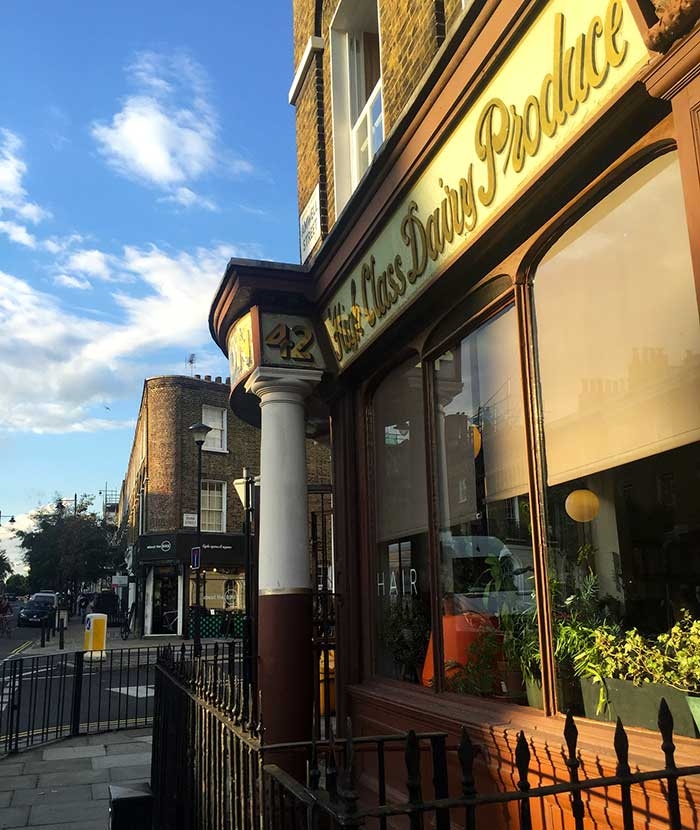
It was in the stone work of the school, the corner window of a deli, the chemist with elaborate lettering on the brown and gold sign. A few doors up, a vintage shop called Pennies had big news tacked to the door: a book swap had finally arrived.
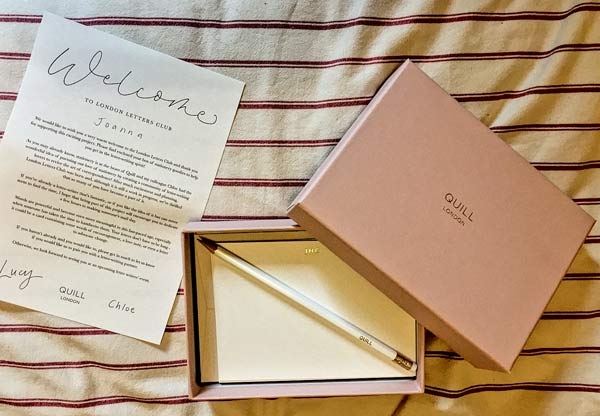
I was looking for a stationery shop called Quill, because a few weeks ago I joined their London Letters Club. It’s this project bringing strangers who like sending actual real handwritten post together – and within 10 minutes of seeing it on Instagram, I’d parted with £30, ticked the box marked “pair me with someone”, and arranged to pick up my member’s pack from the shop.
Even hidden behind scaffolding, Quill is still the sort of shop that makes you not so much want, as need everything in it, immediately, all at once. The assistant hands me my order and introduces herself, then we stand for a few minutes and chat.
I tell her I didn’t expect to find this little writing shop so close to work, on this oddly traditional, village-like street. But then thinking about it later, I think perhaps it fits nicely: vaguely old school and unexpected is pretty much everything that letter writing is.
After I’ve collected my supplies, I pass a sleepy looking pub on the corner and begin the walk home towards Angel, past a gated square and church.
But the feeling of this street – the school, the shops – has intrigued me, so when I get home, I look it up. I find out that the school is 318 years old, and where Charles Dickens did penny readings for the poor. That the sleepy pub used to be pretty famous; poets and writers once brought the house down at a night called Vox ‘n’ Roll.
London is full of these little places, tugs back in time, hidden communities you don’t expect. And streets with pubs where a member of the Pogues once slept upstairs, and Pete Doherty worked behind the bar, serving Irvine Welsh and Johnny Depp.
This post originally appeared in my weekly newsletter, along with links to some really good stuff on the internet, and a list of things to do in London that weekend. Sign up below, if you like.
There’s lots of places in this city that very much do act like London, like St. Paul’s, the Thames, Bloomsbury’s squares, the Barbican’s walls, and the stairway on the north side of Waterloo bridge that always smells like wee.
But not Exmouth Market. It does the opposite.
Exmouth Market reminds me of not being in London.
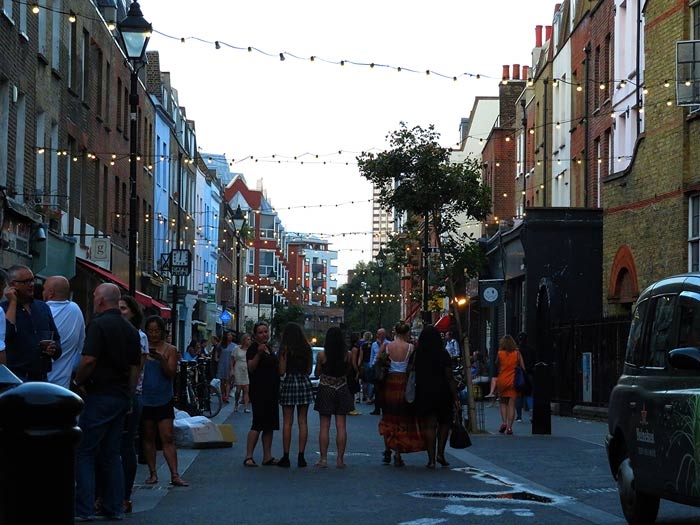
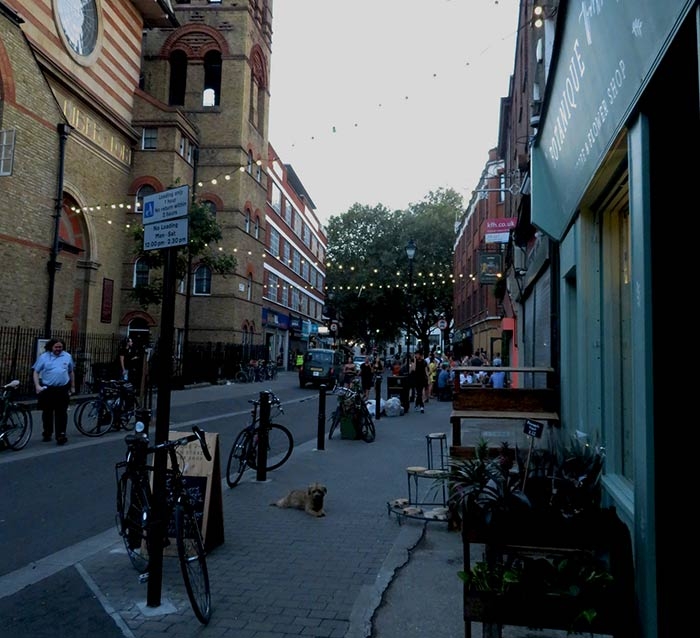
It reminds me, very specifically, of a street in Paris called Rue de Cler; one of those short-ish little pedestrianised streets with tables on the pavements, a low-key market, twinkly lights, little shops, bars with benches facing out, and restaurants serving very good meat.
Like Paris, Exmouth Market is good if you’re hungry.
Which is weird because most places in London that say they’re good for eating actually aren’t. Like Borough Market is good for food but not for eating, because before you eat you have to lose your tiny little mind doing the penguin-shuffle behind literally every tourist in the world first.
And Soho! Soho is good for restaurants, but not for eating, because before you can sit and order food at the table you weren’t allowed to book, you’ll have to form an orderly, boring, hour-and-a-half-long queue.
But Exmouth Market is 100% Certified Actually Good for Eating, by which I mean you can consume very good food quickly and easily at the times of day when you – a hungry human being who is literally. about. to. kick. off. if. she. does. not. get. fed. immediately – requires something to eat.
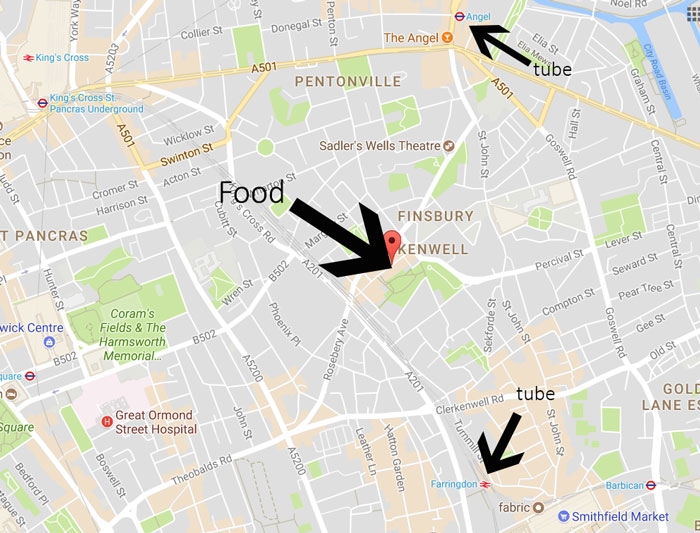
That’s because as this helpful diagram illustrates, this little area doesn’t tend to come up on the London Market Guide Book roll calls for slow walking tourists, and it’s about five minutes too far from Angel and Farringdon for socially active yet fundamentally lazy Londoners who finally came good on their “we must catch up soon!xx” Facebook posts and need somewhere decent for dinner.
So basically, Exmouth Market allows you to do the impossible.
And in this city, impossible is defined as “being able to eat dinner at 7:30pm” in places like Caravan or Pizza Pilgrims, and if not Caravan, then at the bar in Morito, or further down to Santore, where they magic tables out of cupboards and somehow always squeeze you in.
And if all else fails there’s the Exmouth Arms, or Cafe Kick, where it’s fine to skip dinner entirely because you’re smashed on Happy Hour mojitos now and playing table football instead.
Come on, did you really think there wouldn’t be a dog in here somewhere
It’s a good Colleague Birthday Restaurant place too.
Colleague Birthday Restaurants need to be that decent middle ground: not quite Pizza Hut, not quite Hawksmoor, express lunch menu, reliably good food, walk-in table for eight because the person in charge of sorting the collection and card forgot to book.
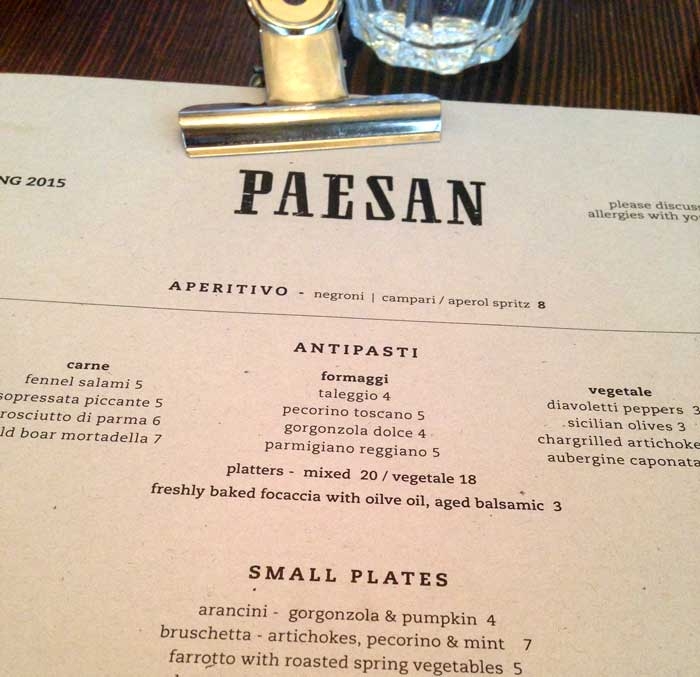
My Colleague Birthday Restaurant of choice is Paesan, which does all those things while managing to serve the sort of Italian food that doesn’t completely embarrass you in front of Italian workmates.
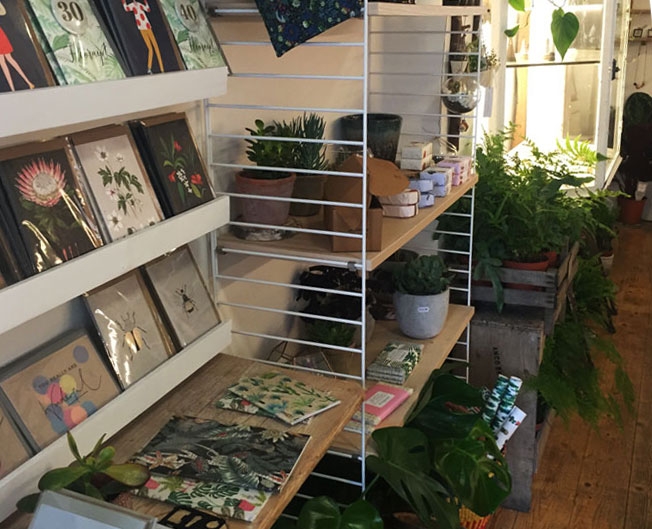
Cards, plants, and everything else you didn’t think you needed to buy on the way home
There’s also a lot of nice little shops.
Exmouth Market specialises in those small independent shops you can kill 15 minutes in – picking things up, putting them down, and patting the shop dog – before leaving with five near identical hand drawn cards with ducks wearing hats on the front while you’re waiting for your mate.
You’ve got Botanique – which sells plants and cards, and joy of joys: two dogs – and Space, which sells stuff made by Londoners, and has been run by a mum and her daughter since 1998.
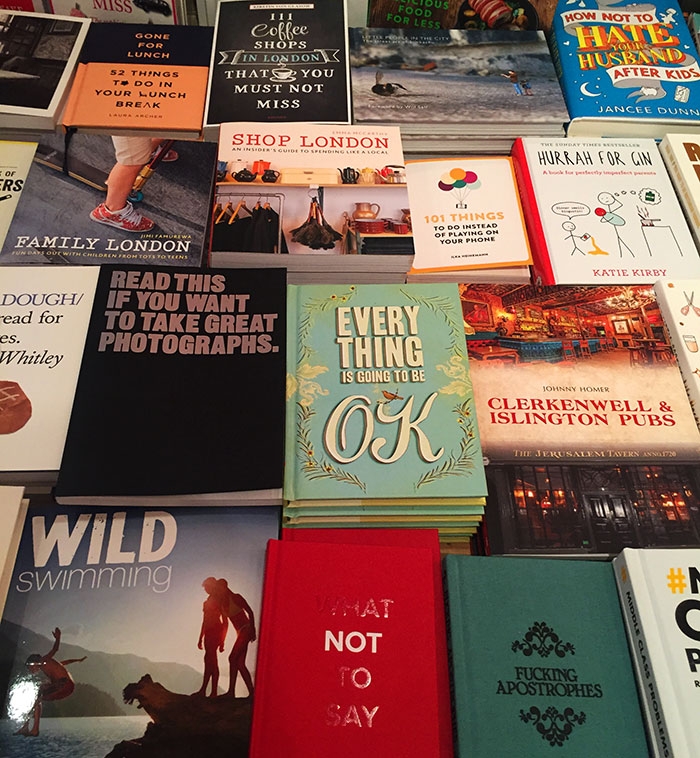
Any shop selling books called “Fucking Apostrophes” is alright by me
It’s also got the an excellently named barber’s shop.
So not only can you say that Barber Streisand‘s cut your hair, but I’m pretty sure they’ve also got a cat. Also, once upon a time actual real Barbra Streisand walked past and Instagrammed their shopfront, which is probably the most meta thing that’s ever happened.
There are some very good looking places in London.
They’re what makes London better than New York. They’re parks, and streets, and houses, and landmarks and buildings that are so inherently London they don’t so much catch your attention, as grab the eyeballs from your face and turn you around.
These places refuse to give you a choice: in their presence, you can look nowhere else.
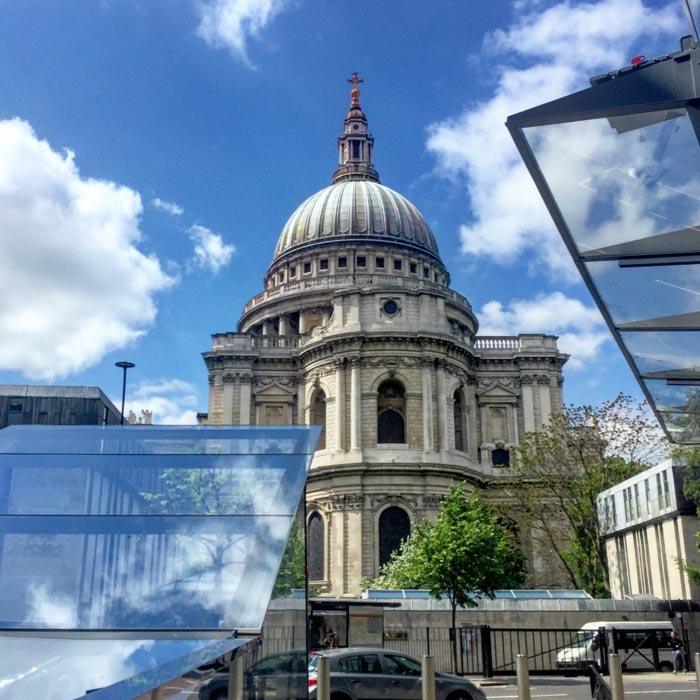
St Paul’s flaunting its curves, as per
It’s something in the colour of the stone, or the detailing under the windowsills, the slant of the glass; the beige grouting between grey-brown walls, exposed foundations, tall ceilings, domed roofs and faded ghost signs advertising a service long defunct.
And once they’ve got you, they beckon you closer like a wizened old woman, they have stories to tell; these parts of London that have been there so long it’s like they grew up out of the ground.
You beauty. (Photo credit: .Martin. creative commons)
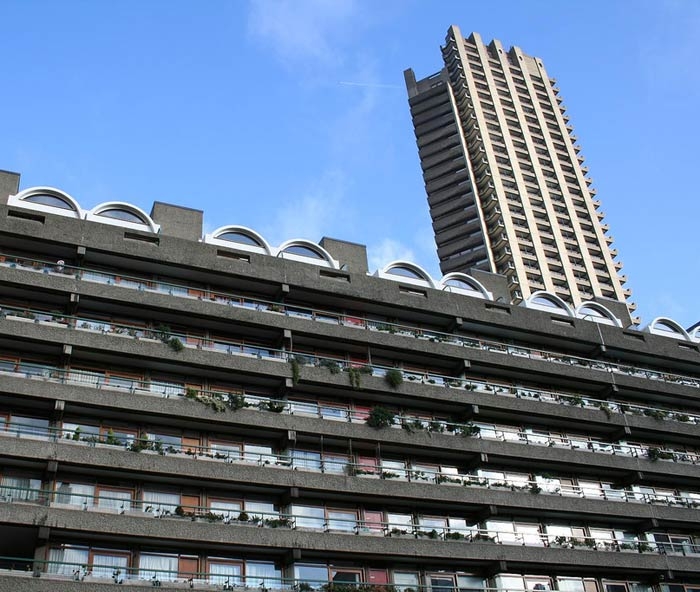
Like St Paul’s, The Barbican is so London it’s got its own tube station, and so un-London that when you come out of it and see a grey looking underpass flanked by the great looming towers of the estate, you sort of wonder why you arrived.
The most obvious reason would be for the art and music.
The Barbican Centre is where the London Symphony Orchestra lives, and also where you’ll go to hear, among other things, the sort of music you’ll be very into if your idea of a good gig is one where you only have to stand up once, and that’s to wave your Union Jack flag.
But the Barbican isn’t just somewhere to drop your parents off for a few hours over Christmas.
It’s not even that bad looking, once you get a bit closer.
In fact, before you get inside, it’s actually pretty cool.
It’s BYO flag
The best way to see all the cool stuff outside is when you’re searching for the entrance.
The Barbican manages to be everywhere you look and nowhere at all, so it’s entirely normal to spend at least half an hour working out how to get in.
If you go one way you’ll eventually find a sign that says “Barbican Cinema” and they’ll direct you to the Silk Street doors over the road, and if you go the other other way you’ll find a sign that says “High Walk“, and, more out of exasperation than anything else, think sod it, let’s give it a try.
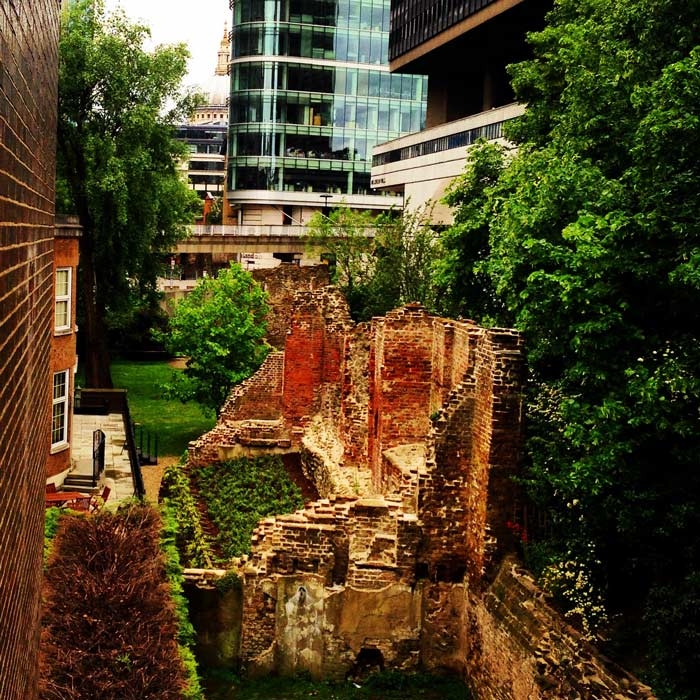
The remains of Old Stuff.
You’ll especially like the High Walk if you’ve lived in London for so long that all the old stuff has started to blend into the background, and a thousand year old landmark is merely a normal thing you see on the way to work.
And when you reach that point, it really helps to see the old stuff set against the backdrop of what was once named the Ugliest Building in London in 2003.
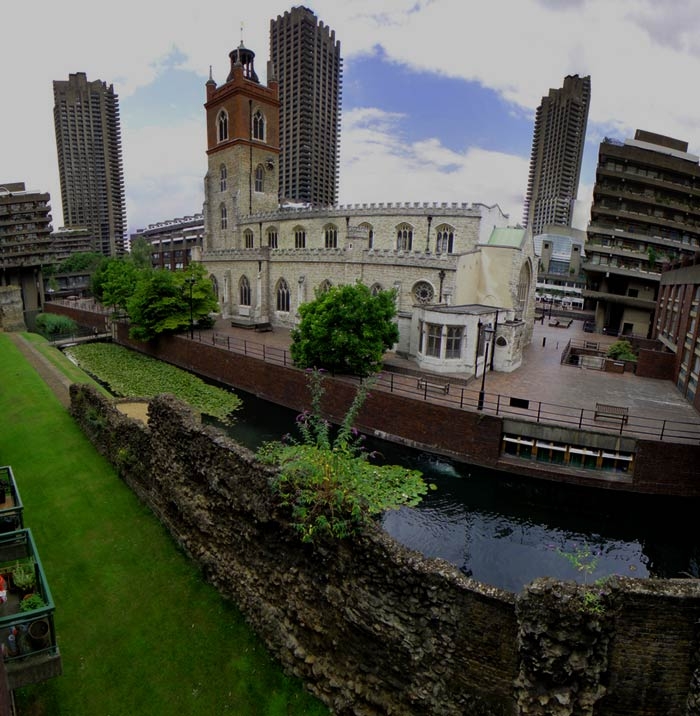
That’s what happens on the Barbican High Walk: you look down, and there, below the rows of identical brown balconies and towering office blocks – are the remains of a bombed out houses from the war (above), a the Medieval church, and a section of the Roman City Wall so old it actually hurts my brain to imagine the time it was built.
Oh. That’s better. St Giles and London Wall (Photo: Matt Kieffer)
The other thing you see are flats.
Lots of flats. Flats that no one ever comes out of. Flats where the only signs of life are the brightly coloured flowers hanging off each and every balcony.
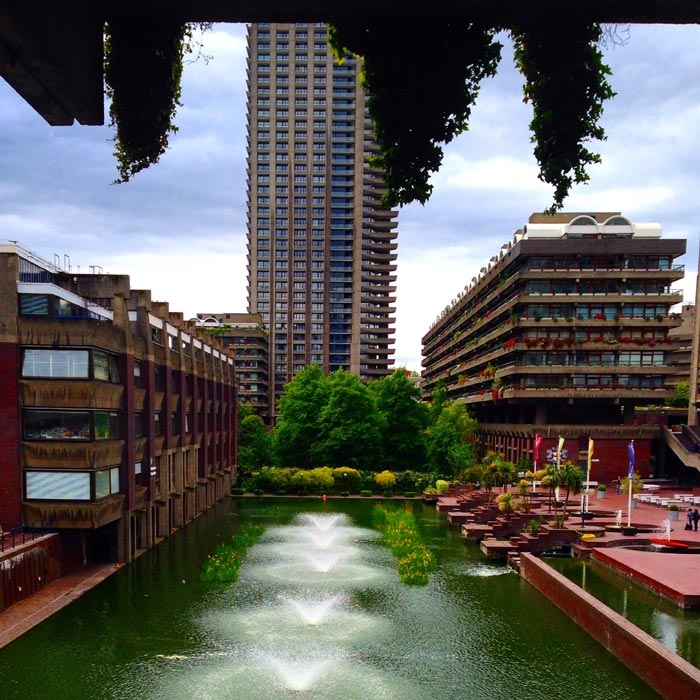
And then you start hearing the splashing of water, and you peer over the other side and you’re like – where actually am I?
Where has this alternative universe appeared from?
Why is there a large green lake, complete with water features and fountains, and plants, and cool little walkways in the water, and a very pretty white church?
And why can’t I see all this from the road?
Once you get inside, the Barbican’s got most things you’d expect from one of the largest performance art spaces in Europe: concert halls, a cinema, a few libraries, photography galleries, art exhibitions, and somewhere to get a cup of tea.
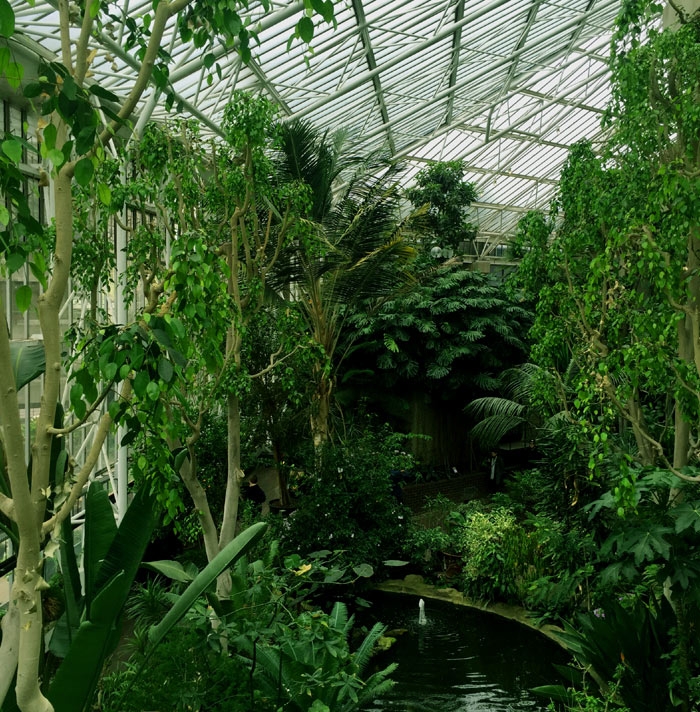
So at this point, we should probably give some credit to whoever decided that what this place really needed was some terrapins, cacti and exotic trees.
If, like me, you often want to see plants without being outside and getting cold, the Conservatory is open on certain Sundays, and is the best place to remind yourself that away from the Thames, there are actually bodies of water in London that can support life like fish.
The easiest way to tell if a place in London is one of your favourites is whether it makes you do your commute on your days off.
And I have to admit that recently, this is what’s started happening. The Barbican has crept up on me. So now, if I want to do some writing, I’ll nip off to the Barbican instead of a cafe. I’ll get the bus through the most ancient bit of London, go along the High Walk, and get a table upstairs inside.
Because that’s the other good thing: as well as everything else that goes on there, it’s a public space. The WIFI’s free, it’s open all the time, and you can spend as long as you want writing or reading without having to guiltily avoid buying another cup of tea.
And say what you want about its looming stance and massive towers, that makes it a very good bit of London for me.